
Out In Time: case study
A meteor is on its way. You have one day, 8am to 8pm, to get as many people out of the city as you can.
I made Out In Time on my own for the Godot Wild Jam, and it placed 7th overall out of 162 submissions. This page covers what the game does, how it was built, and how it went. You can play it right here in the browser.
Play on itch.io →- What
- A browser strategy game about evacuating a city before a meteor hits
- Role
- Solo design, code and audio integration
- Timeline
- Built over the 9 days of Godot Wild Jam #97
- Stack
- Godot 4.5 and GDScript, GL Compatibility renderer, exported for the web
- Status
- Placed 7th overall out of 162 submissions. A full Steam release is in development.
What it does
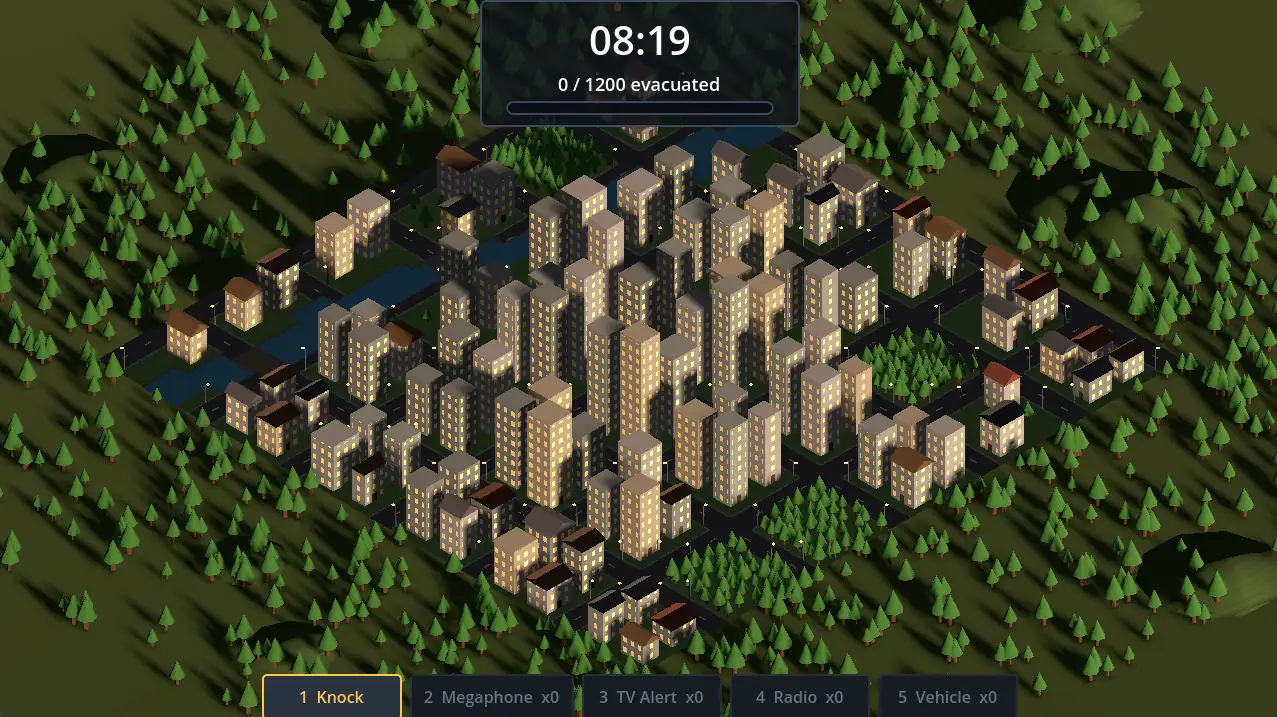
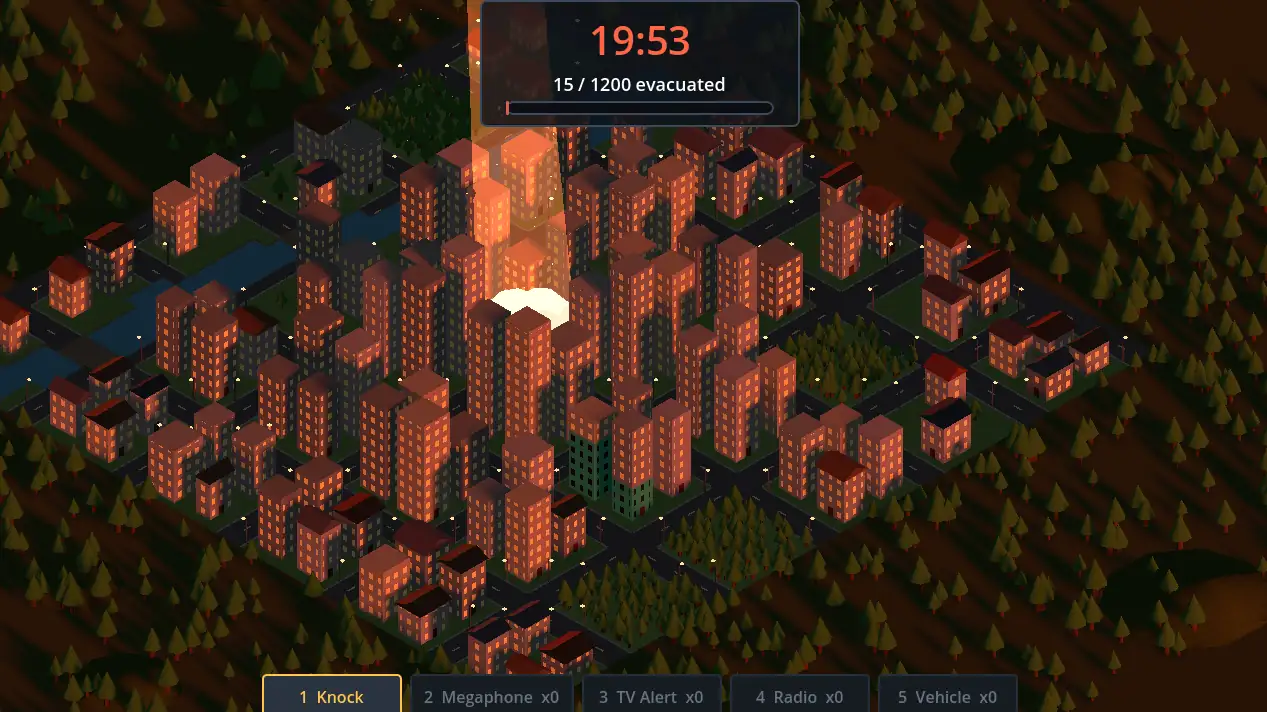
- Get people out before impact. Knock on doors yourself, or buy tools that cover more ground: megaphones, TV alerts, radio broadcasts, and vehicles that drive into the city to collect people.
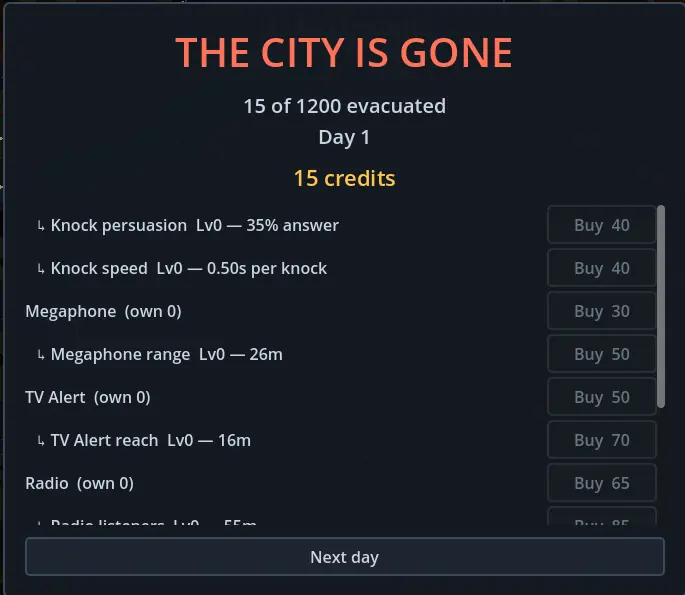
- Spend what you save. Each person you save is worth a credit. You spend credits between days on more tools and upgrades, then try again in a new city.
- Every run goes further. The city is destroyed every time, but your upgrades carry over, so each attempt reaches further.
- Win the day early. The sky turns red as impact gets closer. If you get everyone out before it lands, the day ends early.
Runs in your browser. Loads only when you press play.
Why I built it
I built this game mainly out of curiosity. I had built a few (rubbish) games when I was a kid and since then I've always been interested in game development but never really pursued it much as a hobby. I wanted to change that so had a Google about upcoming game jams and the Godot Wild Jam popped up and it was starting in a few days. My aim was to build a game that would come in the top 50 of the jam and to learn about the game development process from ideation to a feature complete game on Steam. My real focus was on game mechanics, I wanted to learn how to make a game feel fun and engaging within a small scope. I also knew, if I completed this game, it would be a good proof of concept for both my skills as a developer and also future game development. I'd say I proved both of these things with the game and created a simple but extremely fun, enjoyable game loop that ranked in the top 10 of the jam. This was an incredible feeling for me considering I wanted to come in the top 50 and this was my first ‘proper’ game.
Who it's for
The game really is designed for anyone to pick up, play and understand quickly. I had people in pubs playing it on their phones and being able to understand the mechanics within minutes. This felt really good as it meant I had created something intuitive and that is something I will take forward with me into future projects. Since the game was designed for a game jam, it had to be able to be beaten quickly. Most of these games will only be played once or twice, for 10 minutes max, before a rater moves onto the next game. That meant I had to create a game that could be completed end to end quickly but also had that fun and engaging game loop that would make people want to play it again and again. Some of the comments mentioned that they played it far longer than they intended to which again felt really good to me and proved that I'd made something worth playing. Another thing I had to consider was balance. I didn't really want the game to be balanced. I wanted the player to feel overpowered quickly to add to that sense of fun and enjoyment for a game jam. For the future Steam release I will be spending a lot more time on balance to ensure the game is challenging and fun across a 5-7 hour playthrough end to end.
How it was built
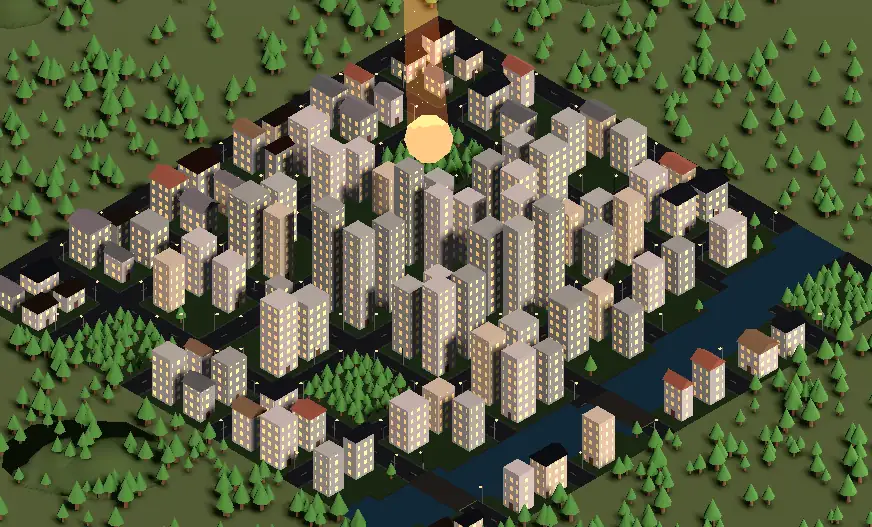
- A new city every run. Each day the game builds a fresh city on a 48 × 48 grid. A winding river runs through it, with bridges where roads cross. There are road blocks, parks, street lamps, and buildings that are tall in the centre and drop to houses with pitched roofs at the edges. Every city gets a generated British-style name, like Thornwickford or Ashmerhaven.
- Population scales with size. How many people live in a building depends on how big it is, then the whole city is adjusted to roughly 1,200 people so every run is fair.
- Evacuation pathfinding. When the city is built, the game also works out the shortest route from every road cell to the edge of the map. Fleeing citizens just follow that, so hundreds of them can move at once with very little processing. Vehicles use A* to drive to a building, pick people up, and take them out of town, with four sizes from car up to bus.
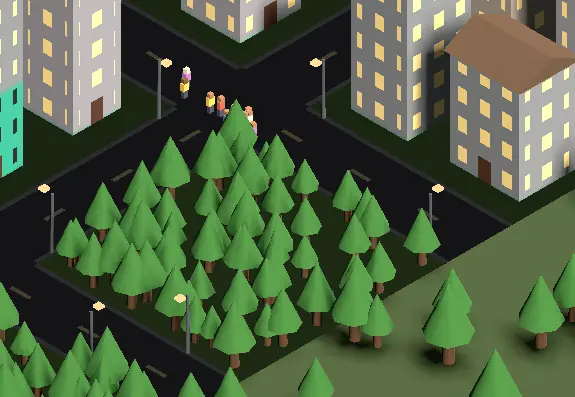
- Fast rendering for crowds. Citizens, trees, lamps and vehicles are each drawn as a single batch, which keeps up to 360 walking people smooth in the browser. All the ground, kerbs, road markings, riverbanks and roofs are generated as one mesh for each city.
- A balanced economy. Every tool has a trade-off between range and how likely people are to respond. The radio reaches far but persuades few. The TV alert persuades most people but covers a small area. Buying more of the same tool gets steadily more expensive, so players have to mix strategies.
- Building the tension. The sun moves across the sky during the day, the light and ambient sound shift towards red as the meteor approaches, and the impact sends a shockwave outward that knocks the buildings down one after another.
- Accessibility and settings. Separate volume controls for sound effects, ambience and UI, a reduce-motion option that turns off screen shake and flashes, and an adjustable day length. Settings are saved between sessions.
Results
- Placed 7th overall out of 162 submissions in the Godot Wild Jam.
- Went from an empty project to a finished, playable web game within the jam's time limit.
- The response from players and the jam ranking gave me the confidence to turn it into a full commercial game.
- Development of a full Steam release is now under way.
What's next
Next comes the Steam release. I feel like I've got a really solid core gameplay loop here and the plan is to expand on it and turn it into a more challenging experience. I want to merge the incremental elements from the game jam with a more puzzly sort of experience to really make a player's choice matter. My plan is to change it up from saving just a city to eventually saving an entire planet. You start out saving a village, then a town, then a city, county, region, country, continent and eventually the planet. Each ‘stage’ will have its own unique challenges and mechanics that all feed into the core gameplay loop of evacuating the area before time runs out and disaster hits. I'm hoping this will make every stage a unique experience with its own gameplay hooks and challenges to ensure the game feels fresh and engaging with the player. I'm aiming for a 5-7 hour playthrough end to end with each stage taking between 30 minutes to an hour and also adding an endless mode for people who want to keep playing and enjoy those style of games.
I'm currently aiming for a March 2027 release, with a demo available on Steam in time for the February 2027 Steam Next Fest. My current pricing plan is to release the game at £5.99 and learn the process end to end of building a game, getting it on Steam, building the Steam page, getting wishlists, learning how to market a game and seeing how it goes and try my best to learn as much as I can from the process.
