

TryTestimonials: case study
TryTestimonials does one job: it gets a small business's happy customers onto its website in minutes, with nothing technical along the way.
I designed, built and run it on my own as a Rally Digital product, and it went from a written spec to a live, paid product in about a week. This page covers what it does, who it's for, the decisions that shaped it, how it was built, and what comes next.
Visit trytestimonials.com →- What
- A testimonial collector for small businesses, coaches and freelancers
- Role
- Design, build and operations, all solo
- Timeline
- Spec written 8 October 2026, live 14 October 2026
- Stack
- Next.js on Vercel, Supabase (Postgres, auth), Paddle billing, Resend email
- Pricing
- Free · Pro $19/month (£15 in the UK) · Lifetime $79 once, limited to the first 30 buyers
- Status
- Live, with the v1.1 Pro release out
What it does
It comes down to three steps:
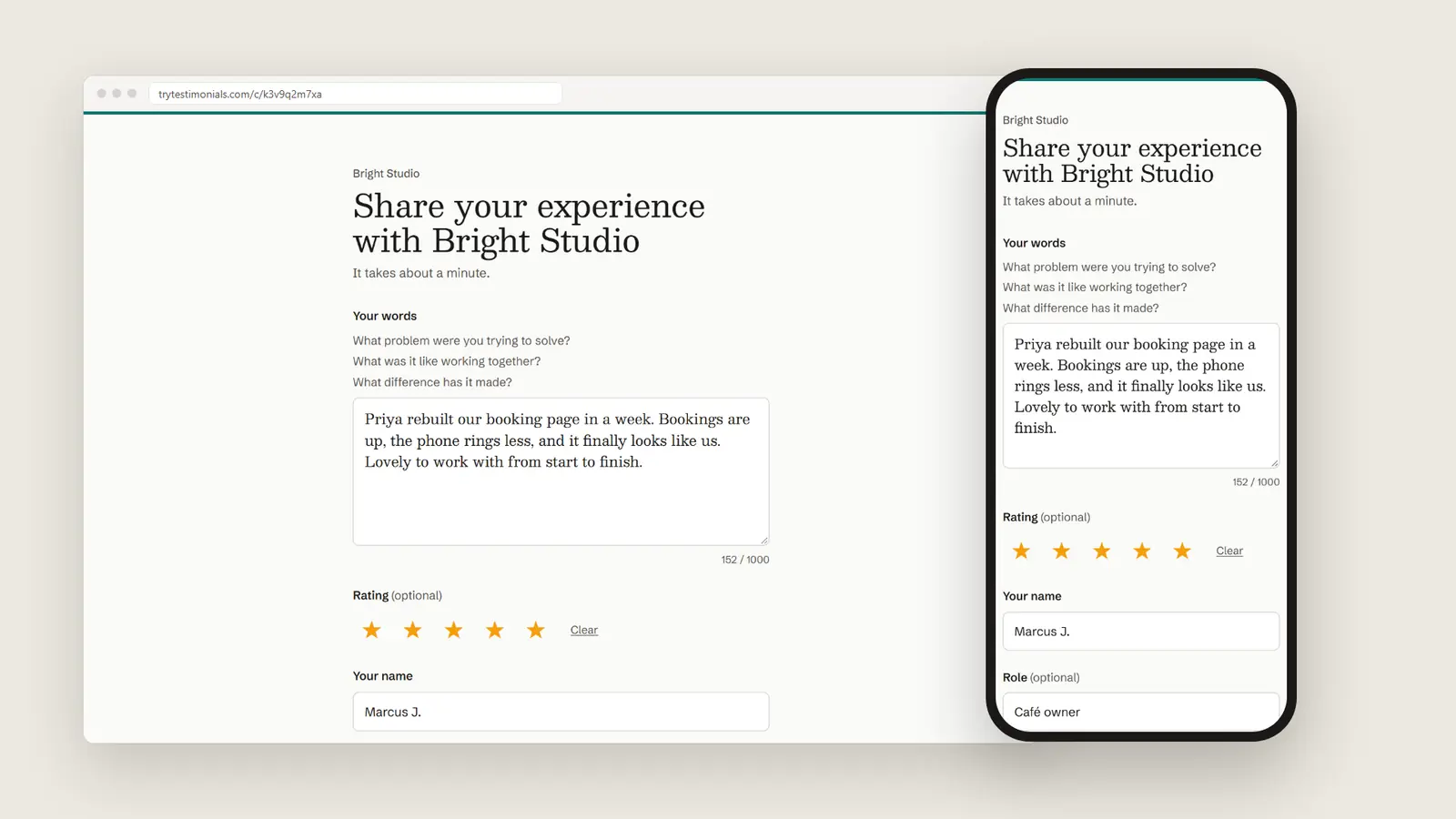
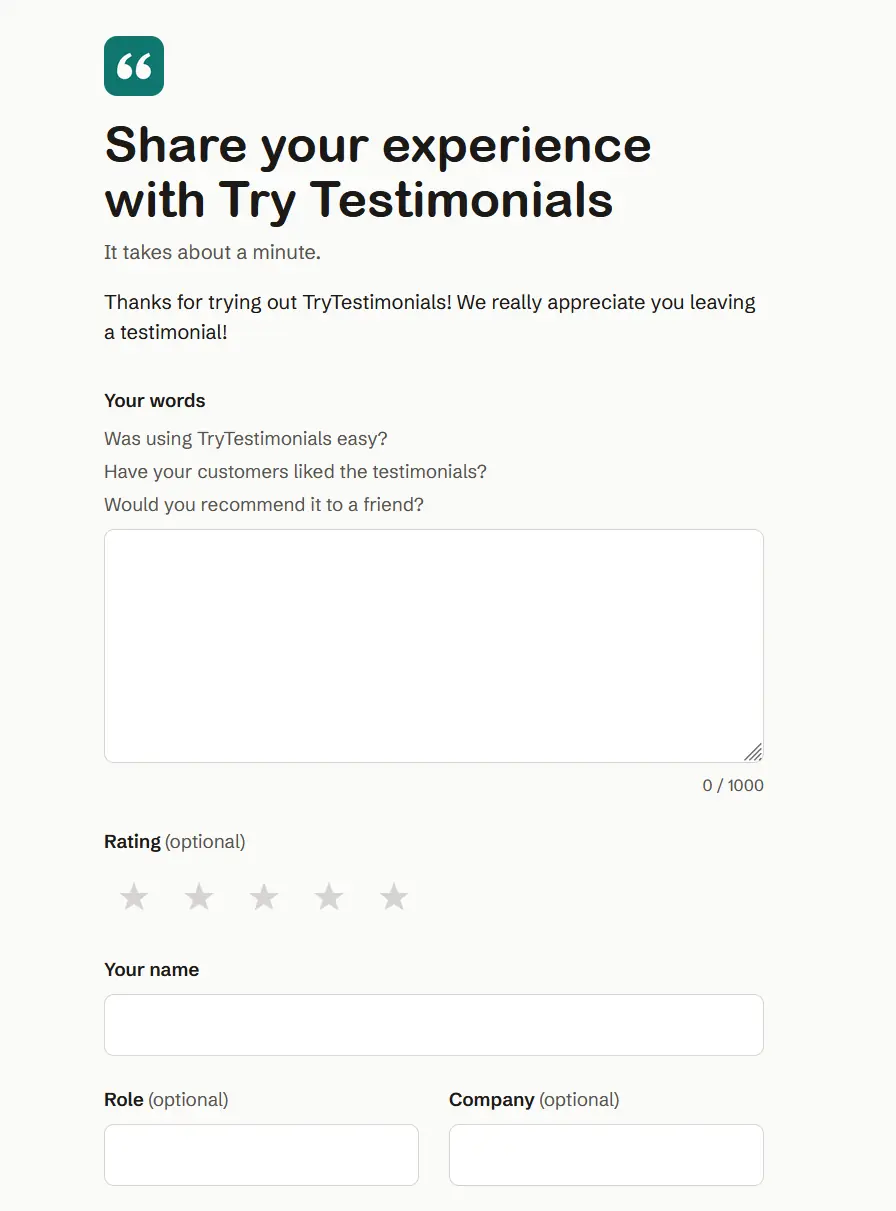
- Send one link. Each “wall” gets a collection page. The owner shares it by email, WhatsApp or a printed QR code, and customers fill it in on their phone in about a minute.
- Approve what comes back. New testimonials land in an inbox. The owner approves, edits or rejects each one, and can undo a rejection. Nothing goes live until it's approved.
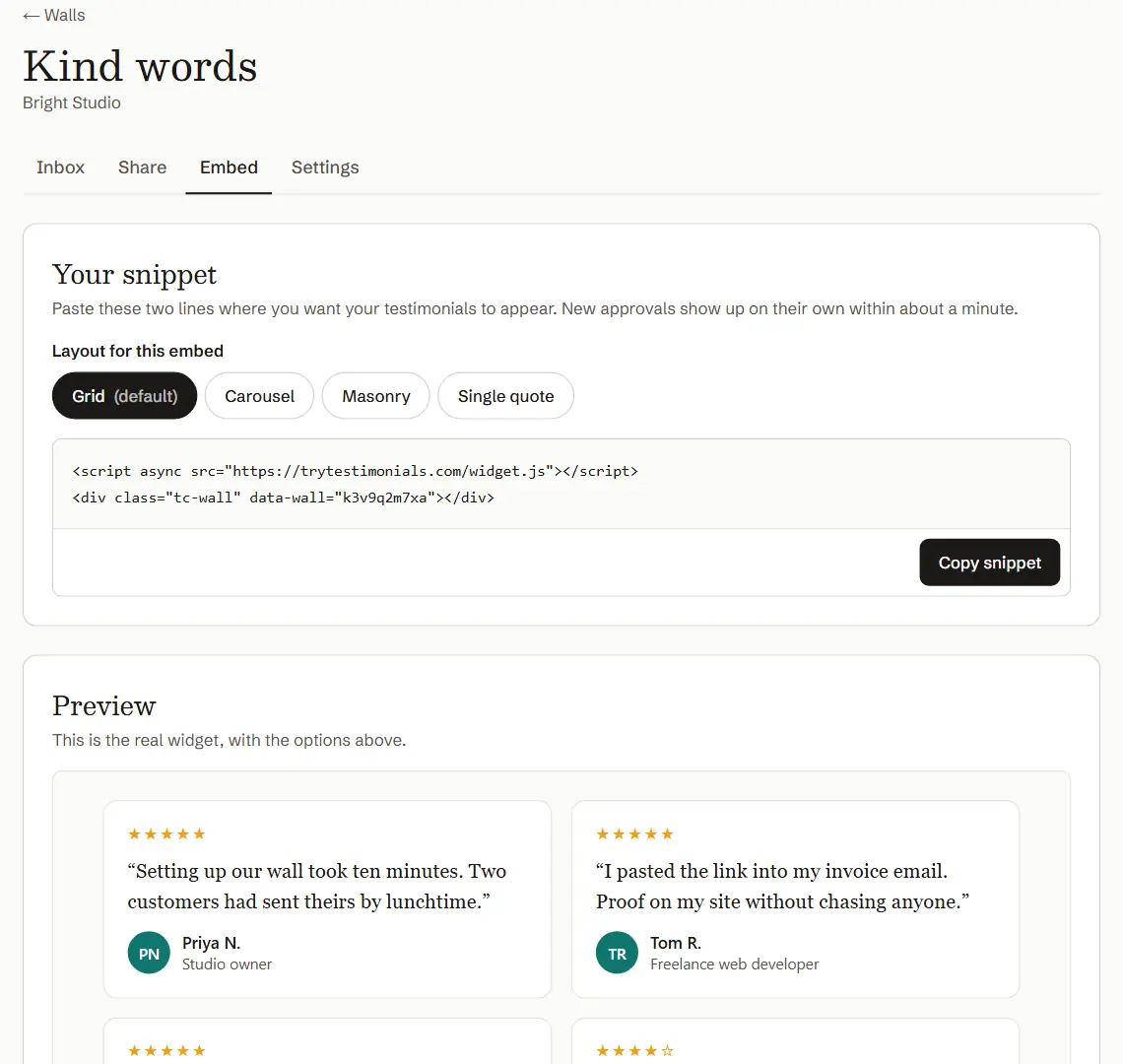
- Show them anywhere. The owner pastes one snippet into their site (WordPress, Wix, Squarespace, Shopify, Webflow, Framer, Carrd or plain HTML), and approved quotes appear there automatically. There's also a hosted wall page for owners who don't want to embed anything.
Owners can also add testimonials they already have from emails or messages, sort them into groups so different pages show different quotes, and export everything to CSV.
Why I built it
Plenty of small businesses have happy customers and nothing on their website to prove it. The tools that fix this mostly serve marketing teams. They offer video recording, imports from many platforms and AI features, and their pricing and setup match.
TryTestimonials is for the other end of the market: a dog groomer, a personal trainer, a freelance designer, a small agency. These people need proof on their site this week and don't want another complicated tool. That shaped a few deliberate decisions:
Video was left out on purpose. Paid-actor videos have made video testimonials feel less trustworthy, and video would break the product's other promises: a one-minute phone form, a tiny widget, low running costs and light handling of personal data. The effort goes into making written quotes more believable instead.
Owners sign in with Google or Microsoft, with no passwords to manage. Every step from creating a wall to embedding it is copy and paste.
The widget is about 3.5 KB compressed, renders inside a Shadow DOM so it can't clash with the site's styles, and sets no cookies.
I designed the service to cost roughly $1 a month until the first paying customer, so Pro can stay at $19 a month and a $79 Lifetime deal is sustainable.
Who it's for
- Coaches and personal trainers. They send the link after a block of sessions and show results-focused quotes on their booking page.
- Freelancers and agencies. They collect a quote at the end of each project, keep a separate wall per service or client type, and use groups to put the right quotes on the right case study page.
- Local service businesses such as groomers, cleaners, tradespeople and salons. They print the QR code on a card or the counter so customers can leave a quote on the spot.
- Shopify and small online shops. They gather reviews without heavy review apps. A dedicated Shopify page covers this case.
- Anyone with a pile of kind emails. They paste in testimonials they already have, so a wall isn't empty on day one.
How it was built
TryTestimonials is a Next.js app on Vercel, with Supabase for the Postgres database and sign-in, Paddle for billing and Resend for email. I built it in phases:
- A local database with security rules and plan limits enforced in the database, not just in the app.
- Collection pages with spam protection: hidden honeypot fields, a minimum fill time, rate limits and hashed IP addresses.
- The owner dashboard and approval inbox.
- The embeddable widget, served from a cached public feed.
- Hosted wall pages.
- Billing through Paddle, with signed webhooks and a real cap of 30 Lifetime sales.
- Launch checks.
Privacy and trust were treated as features, not afterthoughts. Marketing pages set no cookies. Local pricing for UK visitors is worked out on the server, so visitors' details aren't sent to the payment provider before they choose to buy. Every collection form asks the customer's consent before their name and words are shown publicly.
The codebase is covered by more than 80 database security tests and end-to-end browser tests of the main journeys, including real checkout runs against Paddle's sandbox.
Early results
TryTestimonials is a young product, so these are early milestones rather than revenue figures.
- Shipped fast and complete. About a week from spec to a live product with free and paid plans, working checkout, refunds, account deletion and legal pages.
- The v1.1 Pro release is already out. Carousel, masonry and single-quote layouts, brand and card colours, dark mode, font choices, logos, welcome messages, groups and CSV export were all live within days of launch.
- Built from real feedback. A Reddit commenter asked to add existing testimonials by hand, and that shipped within days. Early testers asked to keep the “Powered by” link on paid walls as a way to support the product, so it became an opt-in setting. UK visitors asked why prices were in dollars, and the product now shows local UK pricing including VAT.
- Early testers. Two early testers have Lifetime accounts and have shaped the product with their feedback.
- Owner emails people actually see. A welcome email, a “your first testimonial just arrived” email, and digest emails (daily on paid plans, weekly on Free) keep owners coming back to approve new quotes.
- A foundation for being found in search. Nine setup guides (one for each major website builder, plus two on asking for testimonials), honest comparison pages against Famewall, Senja, Testimonial.to and Shapo, and a free testimonial request generator.
What's next
Near term
- Sell the 30 Lifetime places. The goal is to sell out by the end of November 2026, then shift the focus to monthly Pro subscribers.
- Share as image (v1.2). Turn any testimonial into a square or story-sized image for Instagram and other social sites. Free images carry a small TryTestimonials mark; Pro images use the owner's own colours, font and logo.
- More trust signals on cards. The date a quote was received, a “collected via TryTestimonials” marker and an optional link to the customer, all to make written quotes harder to dismiss.
Later
- A landing page for each website builder (Wix, Squarespace, WordPress, Webflow, Framer, Carrd), following the Shopify page.
- Pro Plus for agencies, at around $49 a month, with 25 walls, five team members and the ability to hand a wall over to a client.
- Request templates for specific trades, such as wording for coaches or dog groomers.
